Background: The question of a harness for design
The use of AI like Claude and Codex to create web pages from designs is spreading. However, the quality of AI implementation depends heavily on the skill of the person using it. How to translate animations into implementation. Where and how to communicate what needs fixing. Designers who can articulate these judgments in words get better results from AI.
As a result, the following challenges have emerged in production environments.
- After delivery, clients who want to update pages must rely on designers to maintain quality
- When non-designers try to implement with AI, trial and error increases and token costs pile up
- AI utilization depends on the skills of certain designers and becomes siloed
In an era when AI implements design, how do we build the "harness" that supports its quality? This is the starting point of this R&D effort.
Our approach: Building a harness for design development with GRAFFITY HARNESS Core
LAMP LLC is a design company that handles web production, UI/UX design, web-based brand building, AI-powered creative production, and AI-driven development. GRAFFITY has been conducting repeated interviews with LAMP, designing a harness for design development using GRAFFITY HARNESS Core, and supporting the R&D effort.
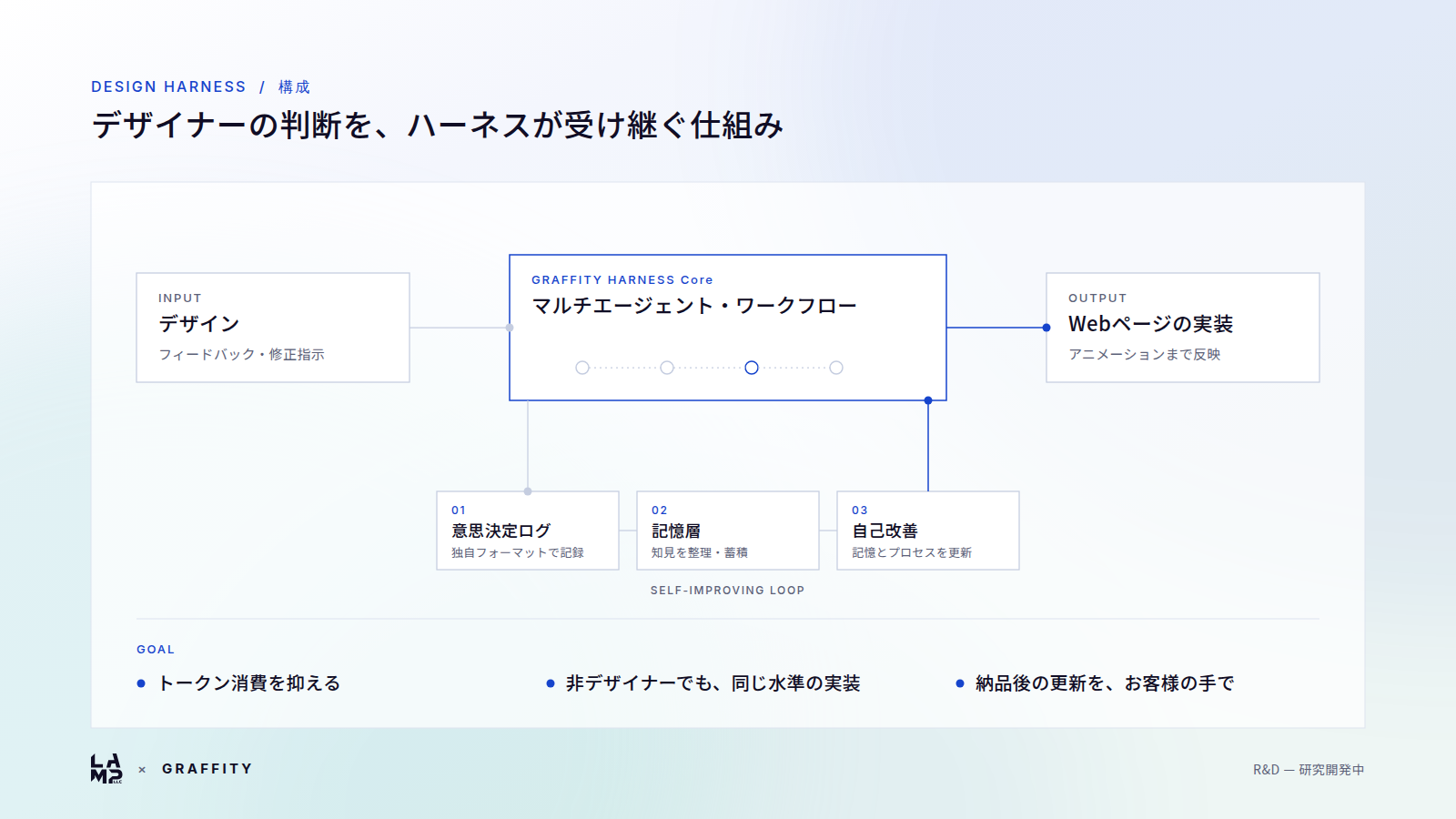
- Multi-agent workflow design: The process from design to implementation is designed as a workflow distributed among multiple agents, aligned with LAMP's production approach.
- Recording decision logs: Each agent's decisions are recorded using GRAFFITY HARNESS Core's proprietary log format.
- Organizing and utilizing the memory layer: Insights gained from logs are organized into the memory layer and applied to future production.
- Self-improvement of the harness: Based on recorded logs, the harness itself makes decisions and updates the memory layer. At the same time, the workflow process itself is also improved.
In practice: Renewal of GRAFFITY's corporate website
This design harness is also being used for the renewal of GRAFFITY's own corporate website. Team members who are not designers were able to implement pages designed in Figma at high quality through the harness.
However, reducing token consumption is still a work in progress. We continue to work on this while improving the memory layer and workflow.
Our goal
If the decisions of skilled designers remain in the system, design implementation can become much more accessible.
- Implement at stable quality while keeping token consumption down
- Even non-designers can implement at the same level
- Post-delivery updates can be managed by clients themselves
Going forward
This effort is currently in the R&D stage. We plan to continue validation with LAMP and share insights on how a design harness can help with design implementation, including reducing token consumption. Details of this effort are also available on our case studies page.
For those considering adopting a design harness
If you want to maintain the quality of AI-based design implementation without relying on specific individuals, or want to pass on designers' decisions to your team and AI, please feel free to contact us. We will support you from design through implementation and operation of a design harness, tailored to your company's production approach.
Inquire about design harness →
Company profile
- Company name: Graffity Inc.
- Representative: CEO Toshiaki Morimoto
- Founded: August 2017
- Location: Plateau Vert 9F, 4-7-1 Aobadai, Meguro-ku, Tokyo
- Business: AX (AI transformation) support (AX consulting / AX solutions), R&D of AI harnesses
- Corporate website: https://graffity.jp